Playing, Part 1 · Chapter 3: Notation and Rhythms
The Treble Clef
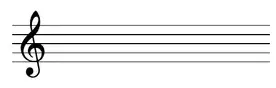
The first clef we'll be looking at is the treble clef. This is used to represent the upper portion of the keyboard—notes normally played with the right hand:
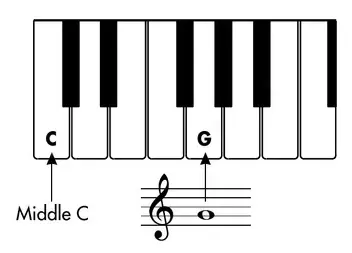
You remember from Chapter 1 that the note G was found between the first 2 black keys in the set of three black keys together. It turns out that the G on the second staff line (from the bottom) of the treble clef, is not just “any old G”—it is specifically the G above middle C. This all-important reference note we call middle C is the C which is found in the middle of the piano keyboard. Go ahead and find it on your instrument!
This clef is a G clef. If you take a close look at the clef symbol, you'll notice the lower part of the symbol circles around the second line from the bottom of the staff. This clef is telling you that the second staff line from the bottom represents the note G. Once we know that, we can easily work out which letter names are allocated to the remaining line and space notes on the staff.
Let's now relate the clef to the notes on the keyboard, as follows:
We said earlier that “line” and “space” notes can be written on the musical staff. Let's now take a look at the line and space notes used in the treble clef:

We've already shown that the second “line note” in the left-hand diagram is G. The other letter names are allocated to the remaining lines and spaces on the staff, according to the musical alphabet. For example, the next note above G on the keyboard is A (as we “wrap around” to the start of the alphabet), and if you look in the right-hand diagram, the note A is the second note shown (a “space note”), which is the next note moving up the staff from G.
Some people like to use mnemonic sayings to learn or remember the line and space notes on the staff. For example, the line notes in the treble clef E–G–B–D–F could correspond to the phrase “Every Good Boy Does Fine.” Also, the space notes F–A–C–E spell the word “face,” of course. Now, as this is a book primarily for beginners, it would be easy for me to recommend that you use these mnemonics (and indeed, other beginner books do exactly that). But the truth is, while they may be fun and handy at the very initial stages of learning, they are not suitable as a long-term way to learn and memorize your notes. Sorry… ! It's actually better to develop a more relative or “positional” technique to learn the note names, particularly when we develop the “Grand Staff,” combining both hands (more about this shortly).
So far we've only been dealing with the white-key names and their location on the treble clef staff (or “treble staff”). Next, we'll see how to notate the black keys. Back in Chapter 1 we named the black keys with either a sharp (♯) or a flat (♭). Now we'll see how these notes are notated on the staff, as follows:
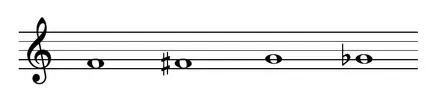
The first note shown above is F, and then the next note is F♯. Notice that this is still in the “F space,” but now with a sharp sign (♯) to its left. Similarly, following the G, we have a G♭, which is still on the “G line,” but now with a flat sign (♭) to its left.Notice how both the sharp and flat signs are exactly on the same line or space as the note they are affecting. When you're writing your own music, remember to write them not too high or too low, relative to the note! I'll sometimes even see this mistake being made by experienced musicians… just a small point, but something to be aware of.