Playing, Part 1 · Chapter 3: Notation and Rhythms
The Bass Clef
On to our next clef, the bass clef. This is used to represent the lower portion of the keyboard—notes normally played with the left hand:
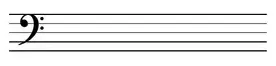
This clef is an F clef. If you take a close look at the clef symbol, you'll notice that the clef seems to be attached to the second line from the top of the staff, with two dots on either side. This tells you that the second staff line from the top represents the note F. Once we know that, we can easily work out which letter names are allocated to the remaining line and space notes on the staff. So let's now relate this clef to the notes on the keyboard, as follows:
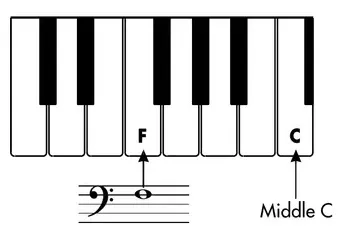
We saw in Chapter 1 that the note F was found to the left of the set of three black keys. The F on the second staff line from the top of the bass clef is actually the F below middle C on the keyboard.
Now we'll take a look at the line and space notes used in the bass clef:

Note that the fourth “line note” in the left-hand diagram is an F, as this is on the second line from the top of the staff (between the two dots in the clef symbol). The other letter names are allocated to the remaining lines and spaces on the staff, according to the musical alphabet.
Again, it's possible to use mnemonics to get acquainted with the notes in the bass clef. For example, the line notes in the bass clef G–B–D–F–A could correspond to the phrase “Good Boys Do Fine Always,” and the space notes in the bass clef A–C–E–G could correspond to the phrase “All Cows Eat Grass.”