Preparing · Chapter 2: Good Posture and Practice Habits
Best Positions for Your Back, Arms, and Hands
The key to having good posture is to be comfortable, but not to be hunched over or slumped in front of the keyboard. Your back should be fairly straight, and your hands, arms, wrists, and shoulder and back muscles should all be relaxed. You should resist any tendency to lean too far forward, and your feet should be resting on the floor. To check that you are sitting at the correct height, your hands and forearms should be parallel to the floor, with the fingers touching the keys, as shown.
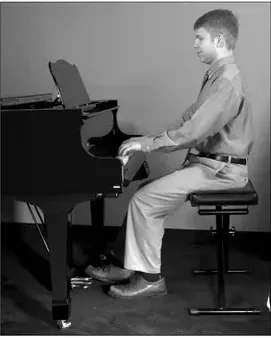
The height of your bench or chair is also important. As shown in the photo, the bench should be high enough so that your forearms are approximately level, with a slight slant downward, toward the keys. A shorter chair would cause the forearms to slant up, producing the need for the wrists to bend down in order to play—bad for the wrists. So, if you do not have a bench that is tall enough, use a phonebook to sit on.
You might be thinking, “Gee, all that posture stuff sounds boring. I just want to play!” Well, guess what? You’ll be able to play much better, and, therefore, play more fun and interesting pieces, if you have good posture!
If you have bad posture (slumped or slouched back, forearms not parallel to floor, too much tension in wrists and/or fingers, etc.), then a number of bad things can happen: backache, cramped hands, even carpal tunnel syndrome. So, good posture is essential (and will enable you to enjoy playing a whole lot more!).
The position of the hands and fingers while playing deserves a special mention here. You should try to keep your fingers curved and your wrists straight, in line with your hands (not a bent wrist). You’ll build better stamina and technique this way, as well as have better access to all the keys on the keyboard.
One way to learn this position is to hold a tennis ball in each hand. This way you will naturally curve the fingers, as shown here:
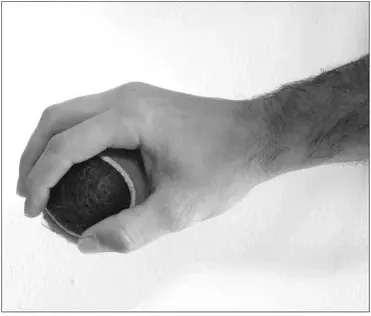
Again, do not tense up when learning this position. Keep the wrist, hand, and fingers as relaxed as possible.