Playing, Part 1 · Chapter 10: Intervals and Chords
Creating Three-Note Chords (Triads)
OK, let's take a deep breath and plunge into the fun world of chords. A chord is created when three or more notes are played at the same time. A three-note chord is known as a triad. Most popular styles are harmonically organized around chords. We'll now use some of the intervals developed in this chapter to "spell" some triads (i.e., figure out what notes we need to build them), starting with the major triad.
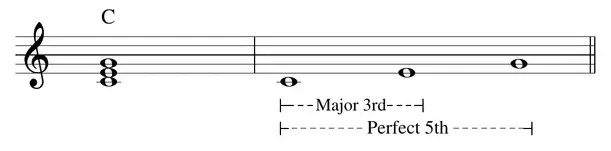
You'll see that I've measured the intervals (major 3rd and perfect 5th) up from the root of the triad in each case. The root is the note from which the triad is based. We refer to the middle note as the third of the chord, and the top note is called the fifth. You'll remember (at least I hope you will!) that these major and perfect intervals are found within the major scale. This triad consists of the first, third and fifth degrees of a C major scale.
Also note the letter C shown above the triad. This is our first example of a chord symbol, which tells you the name of the chord; it is placed above the staff.
A chord symbol that consists of a note name with no additional suffix or description indicates a major triad built from the note indicated, so the chord symbol C means a C major triad.
The major triad is the most basic and fundamental chord, and is used throughout pop and classical styles. So it would be a great idea to learn all of the major triads (i.e., not just C major), don't you think? Well, here they are!

Play through all of these major triads on your piano to learn the sounds and "shapes" of the major triad built upon each of these notes. Use fingers 1, 3, and 5, and try playing the triads with each hand.
Next up, we have the minor triad, which we're also going to spell by using intervals as follows:
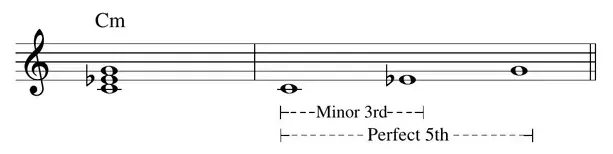
Again, the intervals (this time minor 3rd and perfect 5th) are measured up from the root of the triad. When comparing this triad to the major triad, we see that the third interval (between the root and the middle note, or "third" of the chord) is now a minor 3rd instead of a major 3rd. So another way this C minor triad can be derived is by taking the previous C major triad and lowering the third by a half step (in this case the note E becomes E♭). This is true of all major triads: take any major triad, lower the third a half step, and you have a minor triad.
The chord symbol above the staff is now Cm. There are two components to this chord symbol: the root (C) and the "suffix" or description (m). A chord symbol which consists of a note name followed by the suffix "m," indicates a minor triad built from the note indicated, so the chord symbol of Cm means a C minor triad.
The minor triad is used just about as widely as the major triad, so it's another good candidate for learning in all keys. Note the chord symbols (with the "m" suffix) above each chord:

Although the major and minor triads are the most common, there are two more triads that we will sometimes use, the augmented and diminished triads:
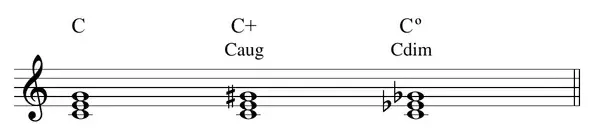
These two new triads are shown above, and we can compare them to the C major triad on the left.
- If we raise the 5th of the C major triad by a half step, we get a C augmented triad. Note there are two chord symbols above this chord—both the "+" and "aug" suffixes are commonly used alternatives.
- If we lower the 3rd and 5th of the C major triad by half steps, we get a C diminished triad. Note there are two chord symbols above this chord—both the small circle and "dim" suffixes are commonly used alternatives.
Play the C major triad on your piano, and then alter it to create the C minor, C augmented, and C diminished triads. Then try the same exercise, starting with different major triads (i.e., not just C major!).