Playing, Part 1 · Chapter 10: Intervals and Chords
Using Intervals in Songs
Next, we’ll see how some of these intervals are used in famous songs. We’ll also see how major intervals reduced by a half step, become minor intervals. We’ll start out with the 2nd:
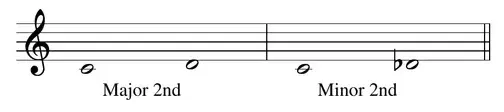
In the first measure we have the major 2nd (C up to D). When this is reduced by a half step, we get a minor 2nd interval (C up to D♭ ) as is shown in the second measure.
Notice that the major 2nd is equivalent to a whole step, and the minor 2nd is equivalent to a half step.
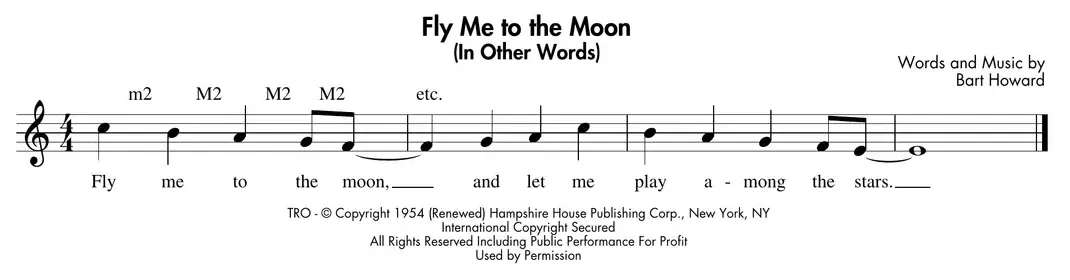
Because whole steps (major 2nds) and half steps (minor 2nds) are the building blocks of scales, you might expect these intervals to show up very frequently in melodies. Well, you’d be right! Here’s our first melody excerpt, containing major and minor 2nds. The intervals are shown above the staff for the first measure (M2=major 2nd, m2=minor 2nd).
Jazz Standards
“Fly Me to the Moon” is a great example of a jazz standard. Jazz standards are vocal tunes, generally written between the 1920s–1950s, which have very strong and enduring melodies. Successive generations of jazz musicians to this day, always “cut their teeth” on the standards. Most jazzers will either play the standards from memory, or from a “fake book,” showing the melody and chords (more about using fake books in Chapters 14 & 15). Here are ten more jazz standards that all piano players should be acquainted with. Although pretty much everything else will most likely change over the next 100 years, it’s a safe bet that these tunes will still be played by 22nd-century piano players!
- All the Things You Are (Jerome Kern)
- Autumn Leaves (Johnny Mercer)
- Body and Soul (Johnny Green)
- A Foggy Day (George Gershwin)
- On Green Dolphin Street (Kaper/Washington)
- Misty (Erroll Garner)
- My Romance (Richard Rodgers)
- Night and Day (Cole Porter)
- Our Love Is Here to Stay (George Gershwin)
- Stella by Starlight (Victor Young)
Next, we’ll spotlight some 3rd intervals (major and minor):
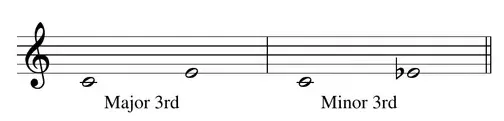
In the first measure we have the major 3rd (C up to E). When this is reduced by a half step, we get a minor 3rd interval (C up to E♭ ).
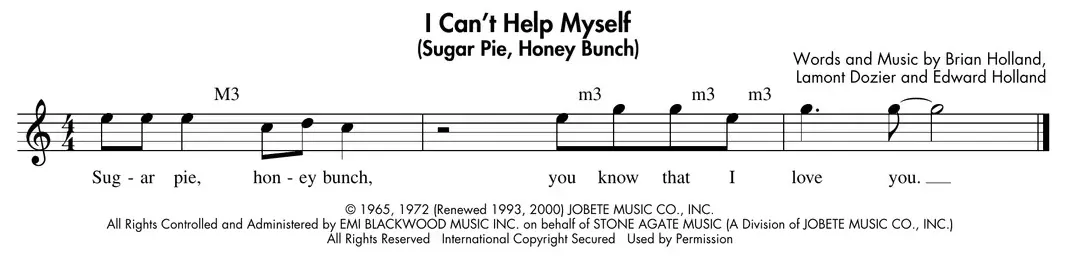
Here’s our next melody excerpt, one from the classic Four Tops’ song “I Can’t Help Myself.” (I had the pleasure of meeting the co-writer Brian Holland when he visited my home studio in Los Angeles a couple of years ago. He was very down-to-earth, and had a nice dry wit!) This excerpt contains both major and minor 3rds (“M3”=major 3rd, “m3”=minor 3rd):
Next, we’ll look at an excerpt of a song which uses perfect 4th intervals. This is “We Are the Champions,” one of the most popular and enduring hits from the rock band Queen (written by Freddie Mercury).
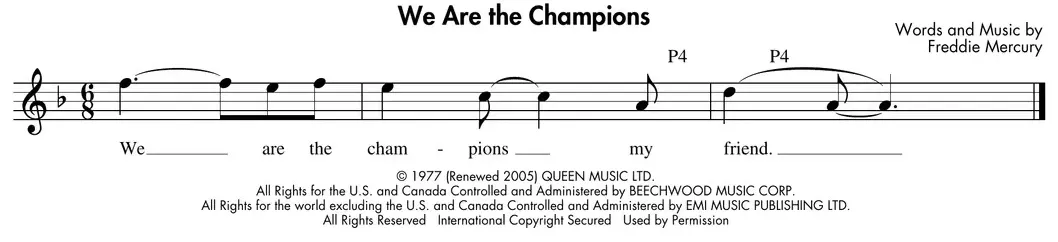
The previous example contains 2nds and 3rds, as well as 4ths. As you play this excerpt on the piano, try to identify the 2nds and 3rds!
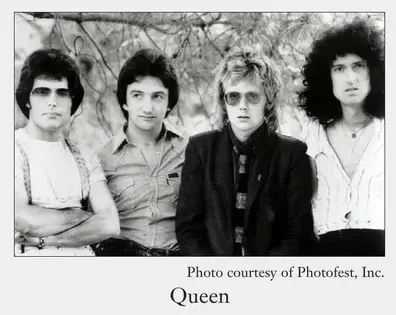
“We Are the Champions” was released in October 1977, and spent ten weeks on the charts, reaching number two and achieving gold status. The song’s great melody and triumphant spirit made it a favorite anthem of soccer fans in Great Britain. Queen’s classic songs and tremendous showmanship made them one of rock’s most important bands of the 1970s and 80s. One of my favorite Freddie Mercury quotes is: “People are apprehensive when they meet me. They think I’m going to eat them. But underneath it all, I’m quite shy.”
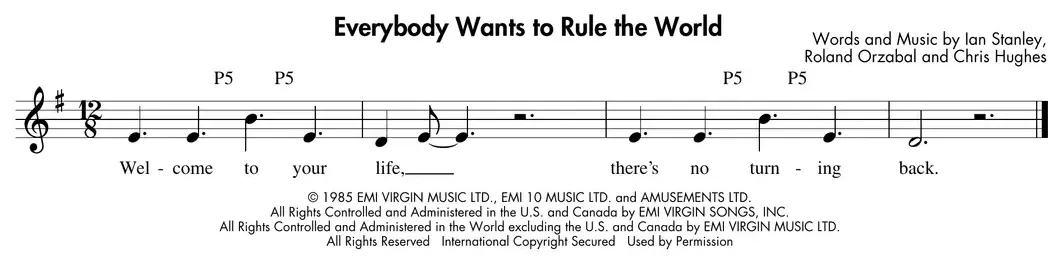
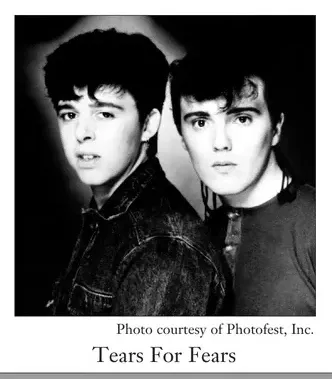
Our next song excerpt uses perfect 5th intervals. “Everybody Wants to Rule the World” is one of the best known anthems from the ’80s synth-pop band Tears For Fears.
About Tears For Fears
The British pop duo Tears For Fears was one of the most innovative bands to emerge from the 1980s synth-pop era. The band was actually a duo, formed by Roland Orzabal and Curt Smith in the early ’80s, after they had both played in a ska revival band called Graduate. The name Tears For Fears was taken from the writings of Arthur Janov, whose “primal scream therapy” influenced much of the band’s work, notably their debut album The Hurting . This became a major hit in Great Britain, generating three Top-Five singles.
By the mid-1980s, it had become a high priority for the band to have a major success on the U.S. charts. This goal was achieved with the hit single “Everybody Wants to Rule the World,” which had a harder-edged, more “American” pop sound.
With its wonderful chorus and innovative guitar work, this song is a classic of the period.
Both this song and the band’s other number one U.S. hit “Shout,” came from their hugely successful Songs from the Big Chair album, which set a new standard for melodic synth-pop.
Next, we’ll spotlight some 6th intervals (major and minor):
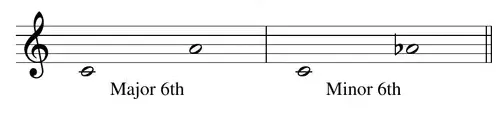
In the first measure we have the major 6th (C up to A). When this is reduced by a half step, we get a minor 6th as in the second measure (C up to A♭ ).
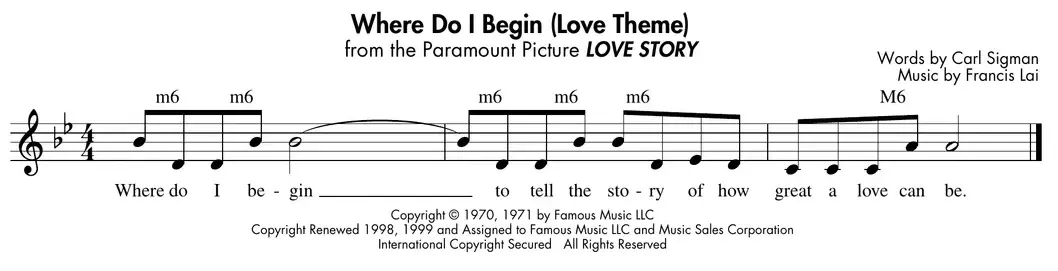
Our next melody excerpt is from the song “Where Do I Begin,” which was the main theme from the movie Love Story. This excerpt contains major and minor 6ths: