Playing, Part 1 · Chapter 10: Intervals and Chords
Diatonic Triads and Progressions
Let’s define a couple of terms that will help you understand this section. “Diatonic” means “belonging to the major scale.” “Diatonic triads” are therefore triads that are contained within the major scale. Here are all of the triads contained within the C major scale:

What we’re doing here is building a triad from each note in the C major scale, making sure that all notes used are contained with the scale (which in this case means they are all white keys… pretty easy huh?). This gives us the various triad “qualities” shown here, from left to right (major, minor, minor, major, major, minor, diminished, major).
The Roman numeral under the staff indicates chord function. Each chord within a key has different tendencies in terms of what kinds of chords they lead to, what kinds of chords they follow, and other tendencies within the context of a piece of music. These Roman numerals actually serve as symbols for chords that have particular functions, or different roles within a key. For more on the specifics of chord function, please see my book Contemporary Music Theory, Level 2, published by Hal Leonard Corporation. For now, all you need to know is that within the key of C, a C major triad is a “I” chord; a D minor triad is a “II” chord, and so on, based on scale degrees.
Now we’ll start looking at triad progressions. These are simply sequences of chords used in songs. Our first example is the chord progression used in “Mr. Jones,” a hit for the rock band Counting Crows in the 1990s. This will also be our introduction to repeat signs in the music.
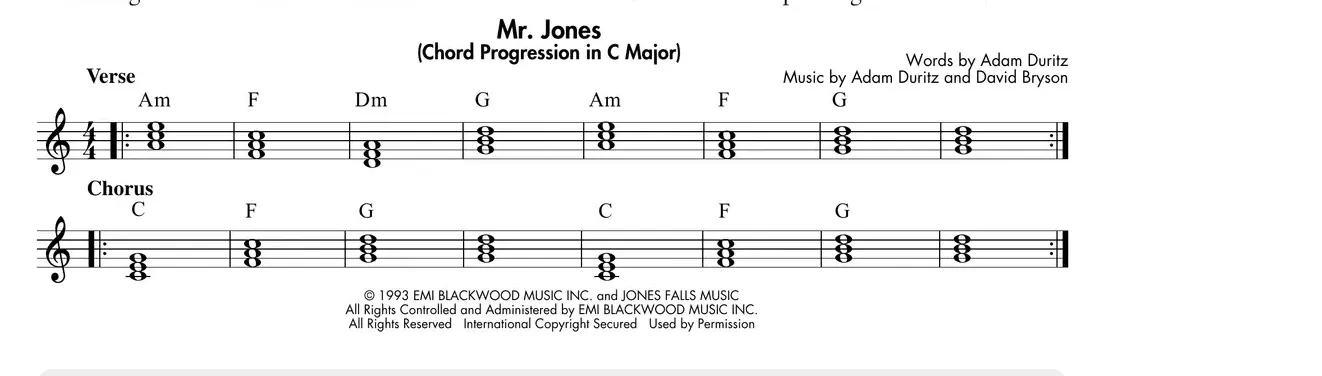
A repeat sign is made up of a thin bar line and a thick bar line, like that of the end of a song. The addition of two dots around the middle line completes this sign, which means to repeat back either to the beginning, or to a previous repeat sign with the dots to the right of the pair of barlines.
Each measure in this song contains a whole-note triad, with a chord symbol above the staff. The key signature of “no flats and no sharps” tells us we are in the key of C major, and all of the chord symbols are diatonic triads from the C major scale (check the previous diatonic triad example as needed). The first line is the verse of the song, and the repeat signs around measures 1–8 tell us to play this line twice (i.e., 16 measures total). Then the next line is the chorus of the song, which is also repeated.
It’s a good exercise to figure out the function (i.e., Roman numeral) of each chord in this song by comparing it to the diatonic triads in the key of C. For example, the first triad is Am (which is a VI in C), the next triad is F (which is a IV in C) and so on. The chords for many simpler songs can be analyzed this way, which helps when you’re communicating with other players, as in, “Hey Nigel, the chorus is a I-IV-V in C!”
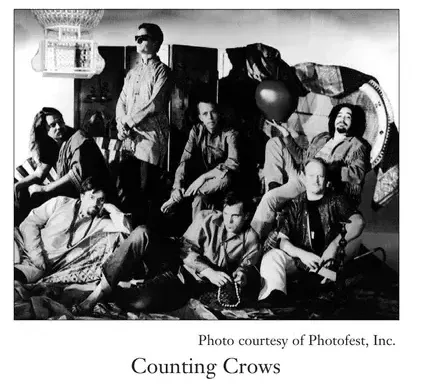
Play through the triads of this “Mr. Jones” to get a feel for the progression, and have a listen to the original song if you can. Although it’s a great tune, the chord progression is very simple and basic!
Of course, we can have diatonic triads in any key, not just in C major! So now we’ll derive the triads within a couple more keys, and look at some songs using these triads. Next up are the diatonic triads within F major:

Again, note the chord qualities above the staff, and the Roman numerals underneath. The famous Beatles’ song “Hey Jude” was written in the key of F, and here’s an excerpt from the chord progression from this song:
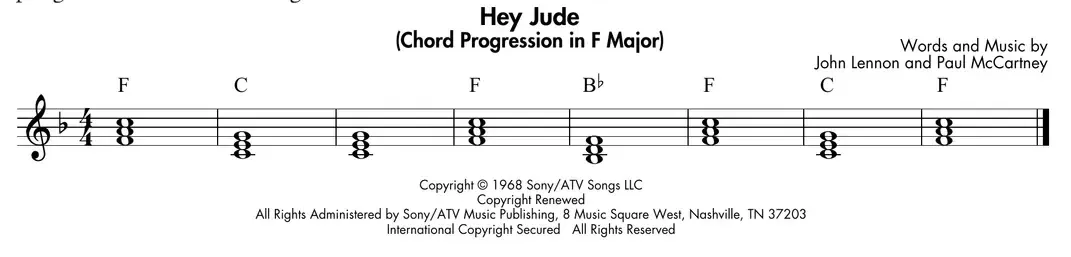
Again, try to analyze the function (I, V, etc.) of each chord in the key of F. Also play through the triads of this song. Many songs use this simple I-IV-V progression, although there are few examples better than “Hey Jude”!
A lot of simpler pop, rock, and country songs use diatonic triads exclusively for their chords. So you get a lot of “bang for the buck” from these. Learn them in as many keys as you can!