Playing, Part 1 · Chapter 7: Major Scales and Keys
The Building Blocks of Scales
In this chapter we’re going to learn about the major scale, which is the most commonly used scale in Western music. Most famous melodies that you know are constructed from major scales. A scale is a sequence of notes created using a specific set of intervals. Most scales (including the major scale) are created using half-step and whole-step intervals, although some scales contain larger intervals. Back in Chapter 1, we saw that the half step was the interval between any note and the nearest note either above or below on the keyboard. Now we will define the whole step as double the size of the half step, as shown below:
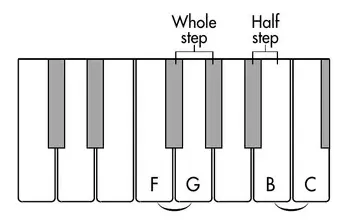
Notice that the whole-step intervals are equivalent to two half steps. For example, the whole step F–G includes two half steps (F–F♯ and F♯ –G), and the whole step F♯ –G♯ includes two half steps (F♯ –G and G–G♯ ). Two half steps are also shown for comparison (A♯ –B and B–C). So now that we have our half steps and whole steps figured out, we can build all of our major scales pretty easily!