Playing, Part 2 · Chapter 14: “Comping” from a Fake Book
Introduction to “Upper Structure” Triad Voicings
Before looking at our next chord progression example, we need to learn about some “upper structure” voicings. An upper structure is a chord in the right hand, played “over” a bass note in the left hand. The simplest upper structures occur when one of the four-part chords we derived in Chapter 12 is “split” so that the root is played in the left hand, and the rest of the chord (the 3rd, 5th, and 7th, which themselves form a triad) is played in the right hand. Thinking in upper structures is a quicker and easier way to figure out and play bigger (4-part and larger) chords. Our next chord chart example consists of four-part or seventh chord symbols.

Assuming we are in the key of C major here, let’s think about how the chords are functioning. We saw in Chapter 12 that the Am7 and Fmaj7 chords are the VI and IV chords in the key of C major. This progression may be labeled as I–VI–IV–I, with all chords being four-part/seventh chords. This is a typical chord progression in pop/R&B styles.
Next, we’ll review how to spell these chords, using the rules we learned in Chapter 12.

OK, just in case you need a quick review of how we built these chords:
- The major 7th chords are built using major 3rd, perfect 5th, and major 7th intervals up from the root.
- The minor 7th chords are built using minor 3rd, perfect 5th, and minor 7th intervals up from the root.
To begin Stage 1 of our comping process, we’ll voice the chords with upper structures by separating the root (placing it “alone” in the left hand) from the other chord tones.

Loading audio…
Listen to track 37 to hear upper structures applied to this four-part chord progression (Stage 1). We can compare this to the chords shown on the previous page, as follows:
- On the Cmaj7 chords, the upper three notes (E, G, B) are in the treble clef, and the root (C) is in the bass clef. To find and play a Cmaj7 chord more easily, you can think of it as an E minor chord over a C in the bass.
- On the Am7 chord, the upper three notes (C, E, G) are in the treble clef, and the root (A) is in the bass clef. This chord may be thought of as a C major chord over an A in the bass.
- On the Fmaj7 chord, the upper three notes (A, C, E) are in the treble clef, and the root (F) is in the bass clef. This chord consists of an A minor chord over an F in the bass.
We’re not quite done with Stage 1 yet, as we still need to use inversions for better voice leading. These inversions will be applied as follows:
- On the Cmaj7 chords, the upper E minor triad is in root position.
- On the Am7 chord, the upper C major triad is in first inversion.
- On the Fmaj7 chord, the upper A minor triad is in second inversion.
Listen to track 38 to hear how inversions promote better voice leading.

Loading audio…
Stage 1 is now completed on this progression, as all the chords are now properly voiced. Next, we’ll move on to Stage 2 and apply some rhythmic interest to these voicings.
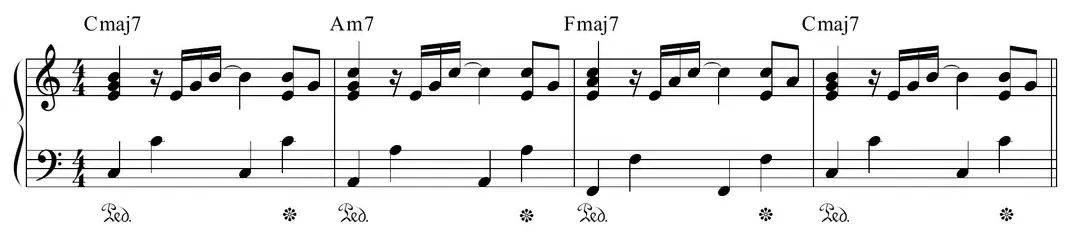
Listen to track 39 to hear Stage 2 applied to this chord progression, using an R&B ballad-type rhythmic pattern.
Loading audio…
The “star-like” signs in the same line as the pedal symbols underneath the staff indicate places to release the pedal.
Just like with the first chord progression, note that your hands are in exactly the same position, and playing exactly the same notes, as in Stage 1. We’re just applying a rhythmic style to make it sound like music!
So now, instead of playing just whole-note triads, the right hand is playing a quarter-note triad on beat 1, and then arpeggiating the triad during beat 2, ending on the last sixteenth note of beat 2 (which is then a sixteenth-note anticipation of beat 3—a classic R&B ballad device). During beat 4, the triad is “split,” with the outer two notes falling on beat 4, and the middle note falling on the “and” of 4. Meanwhile, the left hand is still playing the root of each chord, gently rocking back and forth using octaves. This style will also require the use of the damper pedal for the duration of each chord. Congratulations… you just played an excerpt from an R&B ballad working only from the chord symbols… wasn’t too tough, was it?
Though we carefully analyzed how we applied rhythm and arpeggios to the previous chord progression, eventually you will not need to make such analytical decisions for every little thing you play, and will just “play by feel” like a pro—play what sounds good to you!
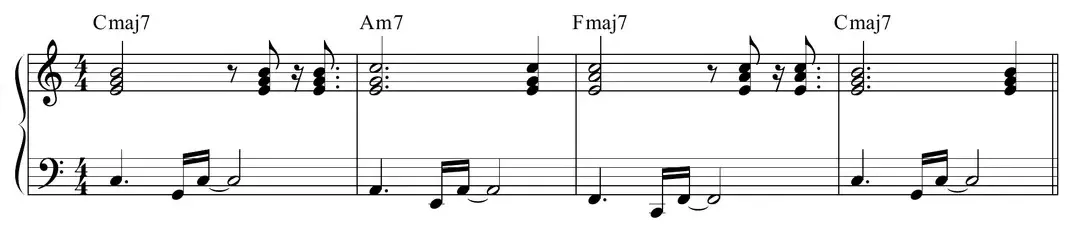
Next, we’ll apply a rhythmic style suitable for a more up-tempo R&B/funk groove. Listen to track 40 to hear Stage 2 applied to this chord progression, this time using an R&B/funk rhythmic pattern.
Loading audio…
In this version, the right hand is playing the triads in a two-measure rhythmic pattern. The first measure of the pattern features syncopation in the chords as they are played in places other than on the beat. The triads on the second sixteenth note of beat 4 impart a strong rhythmic “kick,” helping to emphasize the syncopated nature.
The left hand is playing the root of each chord on beat 1, and then the 5th of each chord on the “and” of 2, returning to the root on the last sixteenth note of beat 2. This last bass note, therefore, anticipates beat 3 by a sixteenth note—a very common sound in funk styles.
When playing these R&B/funk patterns, articulate everything cleanly and be sure to observe the rests, as this helps to bring out the syncopated figures.