Playing, Part 2 · Chapter 14: “Comping” from a Fake Book
Applying the Techniques to Songs
Next, we’ll see some comping techniques at work on a number of different songs. In each case, we’ll look at how the chord symbols have been voiced, and how the rhythms have been applied. We’ll start out with the piano comping figure from one of the Beatles’ most famous songs, “Let It Be.”
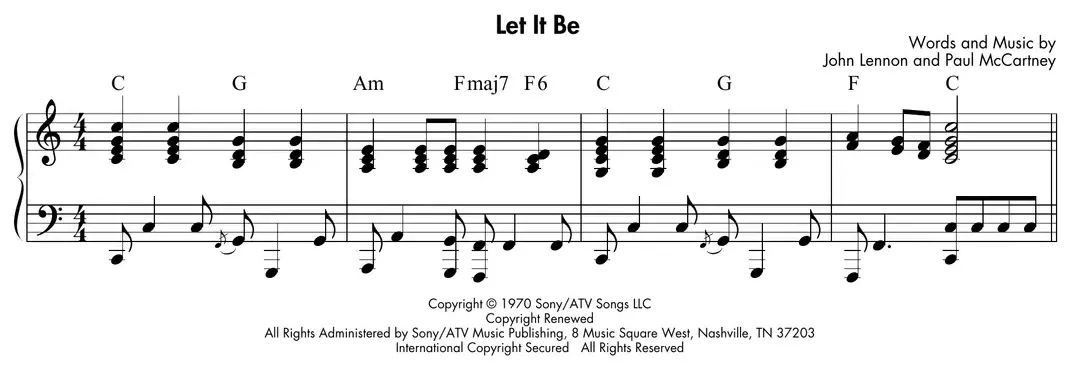
If you play this on the piano, it will be instantly recognized by everyone in the room (unless they’ve been living in a cave for the last 40 years!). Let’s take a closer look at this pattern.
- In the right hand, some octave doubling is being used i.e., doubling the top note of a triad an octave lower. Most of the voicings are simple triads derived from the chord symbol, but the Fmaj7 is voiced with an upper structure: an A minor triad over F in the left hand. Also, the A-C-D on beat 4 of measure 2 is the upper part of an F major 6th (or F6) chord. This may be considered as a variation of the four-part major 7th chord, but with a 6th instead of a 7th.
- The left hand is playing the root of each chord in octaves, landing on beats 1 and 3 (the points of chord change), and then playing on the upbeats in between the right-hand triads, creating a very effective combined rhythm between the hands.
Try applying this very cool ballad pattern to some other chord progressions. Get those fake books out, and go for it!
Everything You’ve Ever Wanted to Know About “Let It Be”…
The song “Let It Be” was released in 1970 and became a Number One hit single. Although it was credited (like virtually all of the Beatles’ songs) to Lennon and McCartney, it was written by Paul McCartney alone. The song has a spiritual, gospellike quality, due to the uplifting nature of the lyrics, and also the piano part which has something of a gospel flavor. On the mix used for the single, the gospel feel is further enhanced by the “church-like” organ used for the solo section. On the album version, however, this was less obvious, as Phil Spector added a raunchy rock guitar solo on the top, sparking an eternal debate among Beatles’ fans about which was the “better” mix. Have a listen to them both and see what you think!
The song (along with the rest of the Let It Be album) was actually recorded in early 1969, but the recordings weren’t released for over a year, as the band wasn’t sure what to do with them. The album was finally released in 1970, and the song hit Number One on the charts in the same week that the Beatles broke up, in April of that year. The fact that Let It Be was the last Beatles’ album to be released, reinforced the impression that the song was unofficially the band’s “epitaph.”
Numerous other artists have covered the song, and many of these versions are rather forgettable. One notable exception is a version by Aretha Franklin, which was recorded in 1969, but not released until the Beatles’ version came out. Some have said that this was because the Beatles decided to make it a single themselves, after they had originally given the song to Aretha Franklin to cover.
Next up is a comping figure from the famous Carole King song “It’s Too Late.” This actually consists of two separate parts: on the record, one was played on an acoustic piano, the other on a Wurlitzer electric piano.
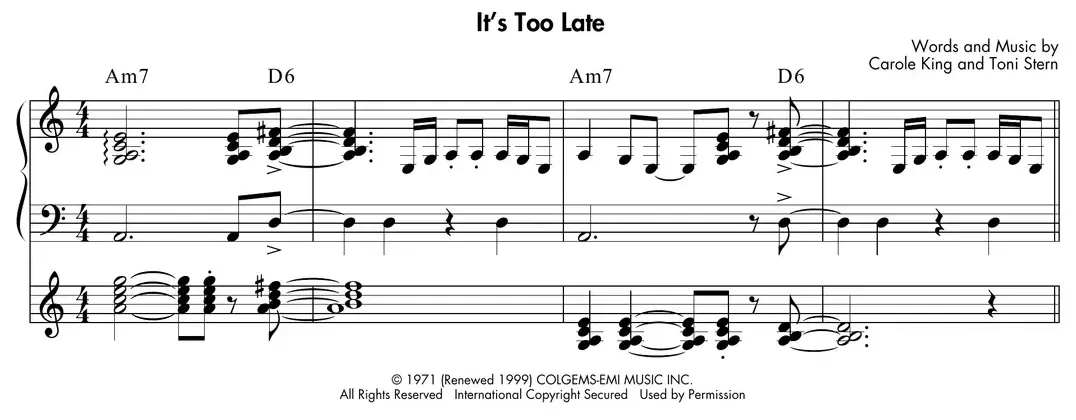
This tune uses another very recognizable pattern, which we’ll now take a closer look at:
- Although this pattern uses some sixteenth notes, they are really just used as ornamentation— the song still has an eighth-note “feel” overall. This tune is typical of an older pop/rock style.
- The right hand of the acoustic piano part is playing complete four-part chords (the Am7 and D6), interspersed with single-note figures towards the end of measures 2 and 4. Each of the D6 chords lands on the “and” of 4, and anticipates beat 1 of measures 2 and 4.
The single-note figures or riffs in between the full chords are actually built from an A minor pentatonic scale, which consists of the notes A–C–D–E–G. This is a commonly used scale across a range of pop and rock styles.
- The left hand of the acoustic piano part is playing the root of each chord, on beat 1 for the Am7 chords, and on the “and” of 4 (anticipating beat 1) for the D6 chords.
- The right hand of the electric piano part is using the same four-part chords, but in different inversions. On the Am7 chords, the electric piano adds some extra rhythm, landing on the “and” of 3 in measures 1 and 3. This adds extra rhythmic energy to the arrangement.
The hit song “It’s Too Late” came from Carole King’s 1971 album Tapestry, one of the most successful pop music albums ever. At that time, she had already earned a reputation as a great songwriter, with songs covered by many artists including the Beatles; Aretha Franklin; James Taylor; the Byrds; and Blood, Sweat and Tears. Tapestry was the ultimate singer/songwriter album of the period—a reflective and thoughtful work that prominently featured her influential pop piano stylings.
It’s time to put your Stetson on. Next, we’ll check out a country ballad comping example.
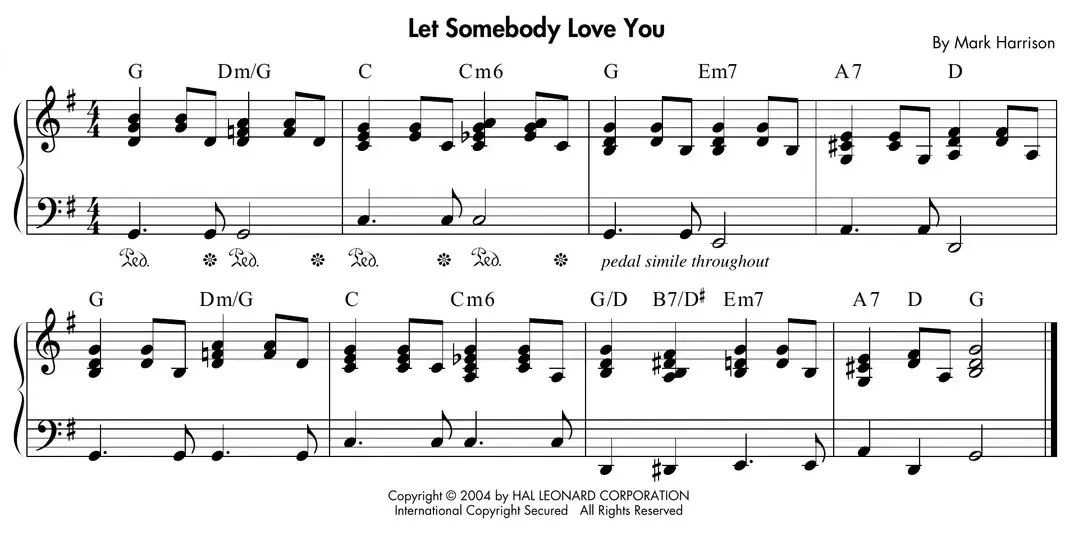
Listen to track 41 to hear “Let Somebody Love You,” a tune reminiscent of ballads by country-rock bands such as the Eagles. Track 42 has a full band accompaniment so you can jam along with the entire group!
Loading audio…
Loading audio…
- The pattern uses eighth-note subdivisions overall, at a slow tempo. This is typical of an older country ballad style.
- The right hand is playing triads and four-part chords in a pattern similar to the pop ballad comping we developed for the first chord chart in this chapter. The difference here is that instead of the alternating eighth-note figure (playing the upper notes of the chord on the downbeat, and the lowest note on the upbeat) occurring throughout the measure, we are now just “alternating” within beats 2 and 4.
- The left hand is playing the root of each chord on beats 1 and 3 (the points of chord change), and then repeating the root on the “and” of 2 (leading into beat 3), and/or the “and” of 4 (leading into beat 1 of the next measure). This type of left-hand eighth-note pickup is common across a range of pop, rock, and country styles.
This example also has some new chord symbols!
- The Dm/G in measures 1 and 5 is a new upper structure. It’s simply a D minor triad with a G in the bass.
- The Cm6 in measures 2 and 6 is a new four-part chord symbol. You can think of it as a minor triad with a (major) 6th interval added.
- In measure 7, the G/D is a major triad inverted over the 5th in the bass, and the B7/D♯ is a dominant 7th four-part chord inverted over its 3rd. These inversions enable the smooth bass movement to occur using successive half steps in measure 7.
Now it’s time to rock ’n’ roll! We’re going to look at the intro from the Bon Jovi classic “Runaway.” This is a single-staff keyboard part (just written in treble clef).
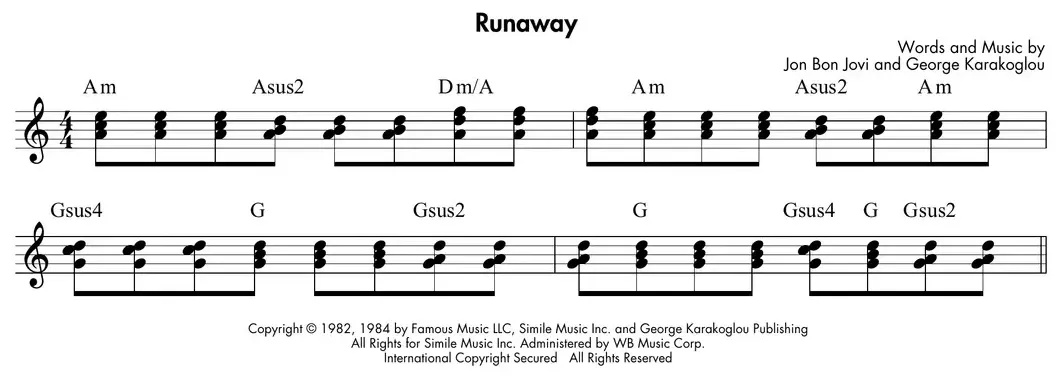
This was originally recorded using a synthesizer, so fire up your synth to play it if you have one—if not, playing it on piano will work fine. This type of driving eighth-note ostinato or repeated figure is common in ’80s and ’90s rock styles. The part consists of different triads and suspensions. The Asus chord in measures 1 and 2 is a variation on the normal suspension, with the added B, which may be thought of as the 2nd or 9th (a kind of double suspension). The Dm/A chord in measure 1 is a minor triad in second inversion.
Runaway
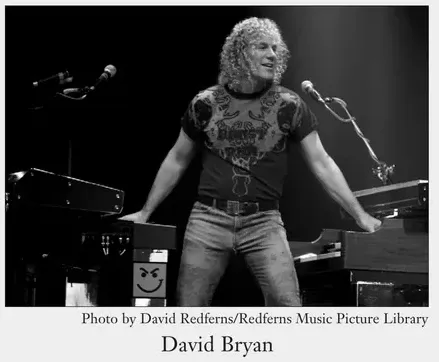
The signature keyboard part on “Runaway” was played by Roy Bittan, a member of Bruce Springsteen’s E Street band and a session ace on many other hit recordings. The song is the first track on their debut album Bon Jovi, released in January, 1984. Although the band could definitely be classed as “arena rock,” keyboards have always played a prominent part in their sound, as played by the band’s regular keyboardist, David Bryan.
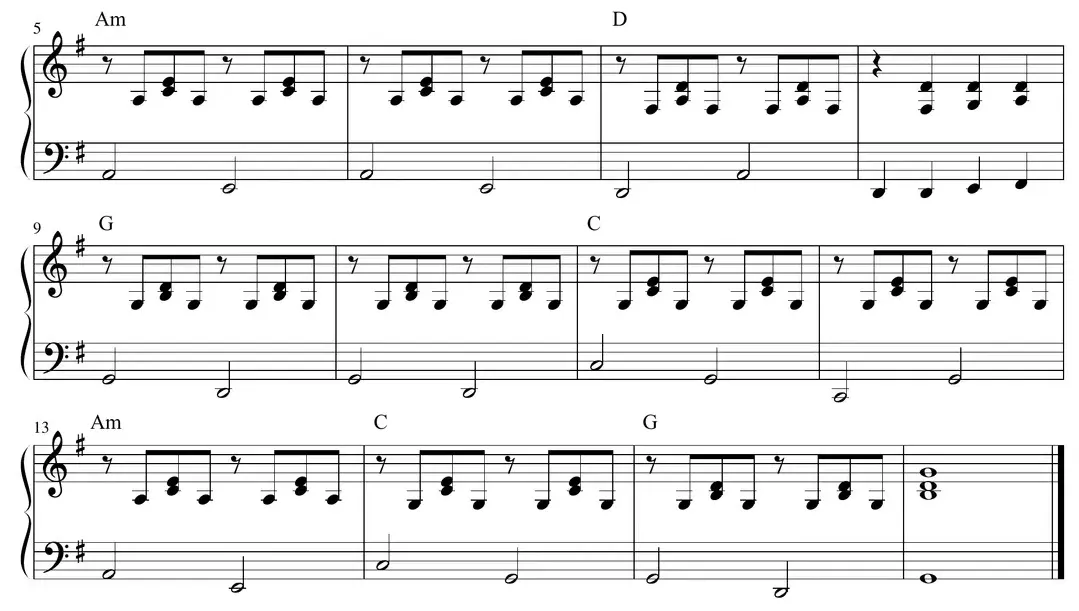
It’s time to look at one more country comping example. This one is in more of an up-tempo, country-rock vein.
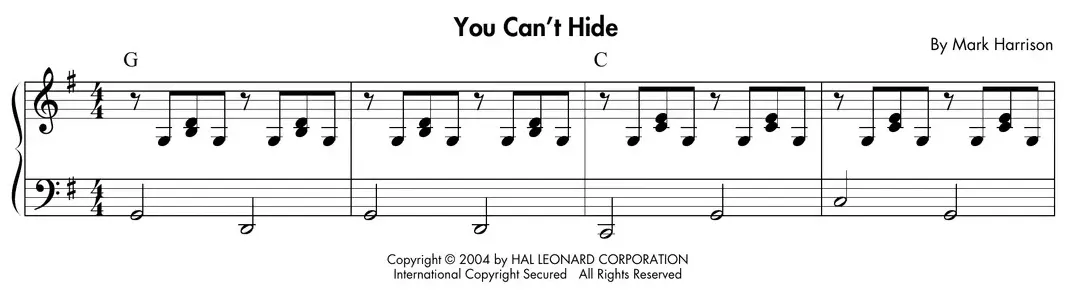
Listen to track 43 to hear the piano-only version of “You Can’t Hide,” a tune reminiscent of country-rock bands such as the Eagles, Poco, and the Byrds. Track 44 has a full band accompaniment so you can “join the band.”
Loading audio…
Loading audio…
- This pattern uses eighth-note subdivisions at a medium-to-fast tempo. This is typical of mainstream country and country-rock, from the 1970s, onward.
- The right hand is playing a similar (“alternating” eighth-note) pattern to the pop ballad example on track 35, but with an important difference: there is now an eighth-note rest on beats 1 and 3. This extra space in the right-hand part helps to give us that authentic “country feel.” The voicings are simply major or minor triads, with the C major chords in second inversion (in the right hand part) for smooth voice leading.
- The left hand is playing the root of each chord on beat 1, followed by the 5th of the chord on beat 3. This is a very common “bass pattern” in simpler country (as well as pop and rock) styles.
This is a great pattern that you can apply to many country and country-rock songs. Find some Eagles’ tunes in your fake books (“Lyin’ Eyes,” “Take It Easy,” “Peaceful Easy Feeling,” etc.) and “fake” your way through the chord changes!
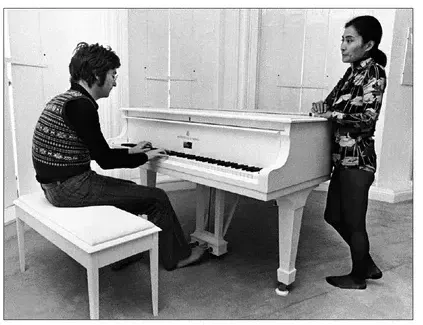
Finally, we’ll end the chapter with another famous comping example, “Imagine,” by John Lennon.
This is our first example showing two bass-clef staffs, instead of the normal treble and bass clefs. The right hand still plays the top staff, and the left hand plays the bottom staff. We notated it this way because the right hand is playing in a low register (below middle C), and to write this in treble clef would require quite a few ledger lines. It’s much more readable to write this part in the bass clef!
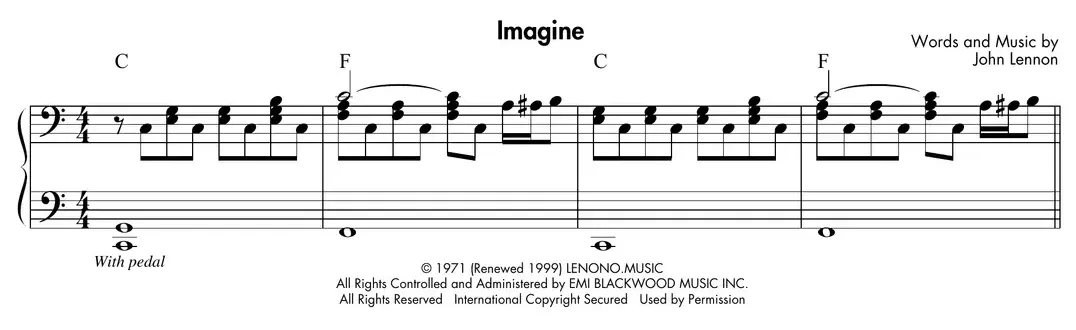
- The right hand adds the 7th of the C major chord on beat 4 of measures 1 and 3. This “upgrades” the chord to a Cmaj7 (with an “upper structure” E minor triad) overall. Also, the 5th of the F major chords (C) is being added on top in measures 2 and 4, resulting in “octave doubling” (C’s are on the top and bottom of this triad figure). Then during beat 4 of measures 2 and 4, there is a “signature” melodic phrase using ascending half steps: A–A♯ –B.
- The left-hand part is playing just the roots of the chords, except for the “root-5th” interval (C up to G) that is played on the first C major chord.
These subtle enhancements show how a simple comping pattern can be turned into something unique and identifiable. Practice adding your own subtle enhancements to all your comping parts to develop your own special playing style.
The examples we went through in this chapter show what kind of comping parts are possible from various chord progressions in a few different styles of music. After studying and playing them, it is up to you to go to your fake books and try creating your own comping parts. At first, pick tunes with very simple chord progressions (i.e., triads, and 3 or 4 chords only), then work your way up to more complex tunes. Comping parts are also great to sing along with (actually, that’s one of the main purposes of comping), so try your hand (voice) at some singing along with what you’re playing, once you get the parts solidly under your fingers.
Have fun!
Everything You’ve Ever Wanted To Know About “Imagine”…
“Imagine” is John Lennon’s best-known song from his career as a solo artist. He wrote the song in 1971, after his first solo album John Lennon/Plastic Ono Band was released. During this period, his political views and concerns were increasingly apparent in his songwriting, and the lyrics to “Imagine” include criticisms of capitalism and religion. However, the song had such a great melody and uplifting spirit that it became universally popular, even with people who presumably did not share Lennon’s views on these subjects.
Lennon composed the song at the piano, inspired by the poetry book Grapefruit, written by his wife Yoko Ono. He said that the message of the song was “sugarcoated” compared to “Working Class Hero,” another of his classic songs which had a decidedly more bitter flavor and mood. “Imagine” was the title track on his second album, which was released in 1971 and went gold, topping the charts in the U.S. The song was also a hit single in the U.S. in the same year, and was released three times as a single in the U.K.: in 1975, 1980 (following Lennon’s assassination, when it hit Number One), and 1999.
“Imagine” has been covered and recorded by dozens of well-known artists over the years, including:
- Diana Ross
- Andy Williams
- Average White Band
- Chet Atkins
- Liza Minnelli
- Henry Mancini
- Ben E. King
- Randy Crawford
- Richie Havens
- Ray Conniff
- Joan Baez
- Blues Traveler
- Roger Whittaker
- Gerry and the Pacemakers