Playing, Part 1 · Chapter 7: Major Scales and Keys
Introducing Key Signatures
When we play the C major scale, we can hear that the note C sounds like the “home base” or “tonic” of the scale. If a song uses the C major scale, it is most likely in the key of C major.
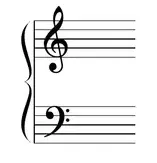
A key signature is a group of sharps or flats at the beginning of the music, which lets you know which key you are in (and which major scale the song is based on). You probably didn’t notice any key signatures in the songs we’ve played so far. That’s because all of our songs have used the C major scale up to now, and have, therefore, been in the key of C, and the key signature for C major is “no sharps and no flats.” Let’s compare this to the key signature to the right, for F major:
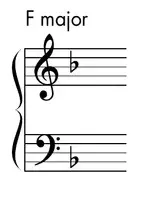
Relating this to the F major scale we built earlier, we remember that we needed the note B♭ as the fourth degree of this scale. The key signature is reminding you to play B♭ (instead of B) when playing in the key of F. That way we don’t need to keep writing flat signs for the B♭ notes that come up in the music. Pretty cool labor-saving device, huh? Now look at the key signature for G major.
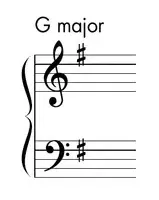
Relating this to the G major scale we built earlier, we remember that we needed the note F♯ as the seventh degree of this scale. So the key signature is reminding you to play F♯♯♯ (instead of F) when playing in the key of G. That way we don’t need to keep writing sharp signs for the F♯ notes that come up in the music. Here are all of the major key signatures, for your reference:
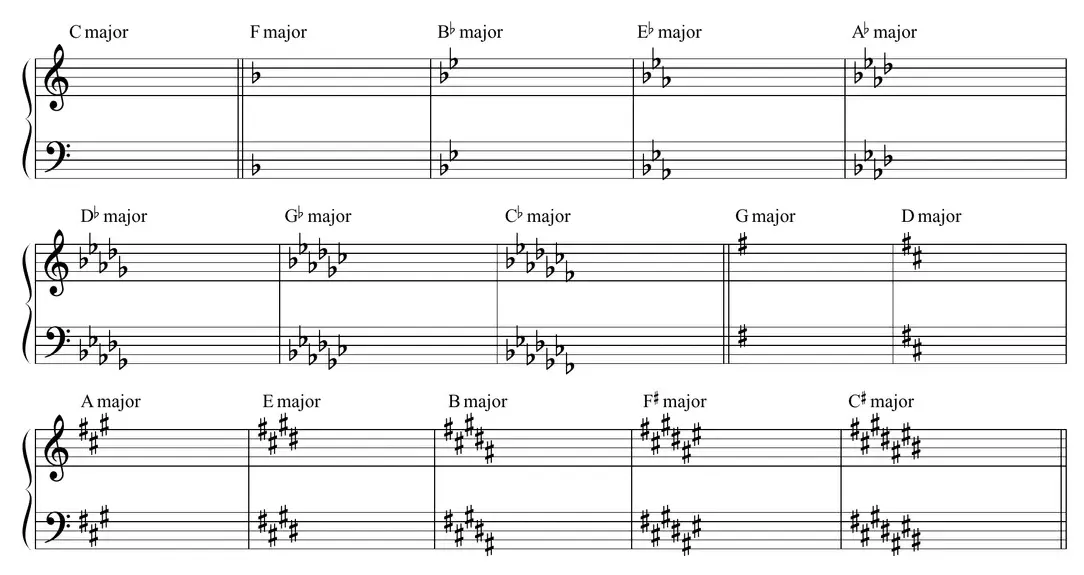
You’ll notice that the key signatures consist of either flats or sharps, but not both mixed together. This is because there are no major scales which need both flats and sharps.
Now, if you’re reading a piece of music and you see a key signature at the beginning, it’s very handy (not to mention, essential!) for you to recognize the key that you’re in. That way you’ll know what major scale the song is based on, and if you’ve practiced your major scales, your fingers will know what flats or sharps you’ll need to play.
When looking at the flat key signatures (those containing flats), the second to last flat in the key signature is the key that you’re in. For example, looking at the key signature of A♭ major, we see there are four flats. The second to last flat in the key signature is A♭ , your key! For sharp keys, the last sharp in the key signature is the seventh degree of the key that you’re in, so you just need to go up a half step from this note (using the next letter name in the music alphabet) to find the key. For example, looking at the key signature of A major, we see there are three sharps. The last sharp in the key signature is G♯ , so if we go up a half step from this note (and go to the next letter name) we get to A, our key!