Playing, Part 1 · Chapter 6: More Notation and Rhythms
Introducing Dotted Notes
Now we will go boldly into the realm of dotted notes! Whenever a dot is placed after a note, it adds half as much again to the rhythmic value or length (or if you're a math whiz, it multiplies the existing length by 1.5). Let's check out the following example:
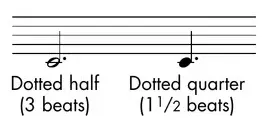
Without the dot, the first note above would just be a half note (lasting for 2 beats). But with the addition of the dot, we add half as much again to the original length, so the note now lasts for 3 beats. Similarly, without the dot, the second note would just be a quarter note (lasting for 1 beat). But with the dot, we add half as much again to the original length, so the note now lasts for 1½ beats.
Next, we will see some typical ways in which these dotted notes can be used in a melody. If we use a dotted half note together with a quarter note (1 beat), the resulting total of four beats will fill a 4/4 measure. If we use a dotted quarter note (1½ beats) together with an eighth note (½ a beat), the resulting total of two beats could occupy the first or second half of a 4/4 measure. These are extremely common rhythmic combinations, as shown in this sample melody:

Loading audio…
Play this eighth-note rhythm pattern and melody using the right hand C Position, while counting along. Listen to track 8 to “check your work,” (did you play it evenly and count correctly?) and then play along.
It's good practice to count all of the eighth notes (i.e., 1 & 2 & 3 & 4 &, etc.) in this example as you play it, even though you are not playing on all of these rhythmic subdivisions. That way your rhythm will be correct and even, and when an eighth note comes along (for example, the F in the second measure), you'll be ready for it!
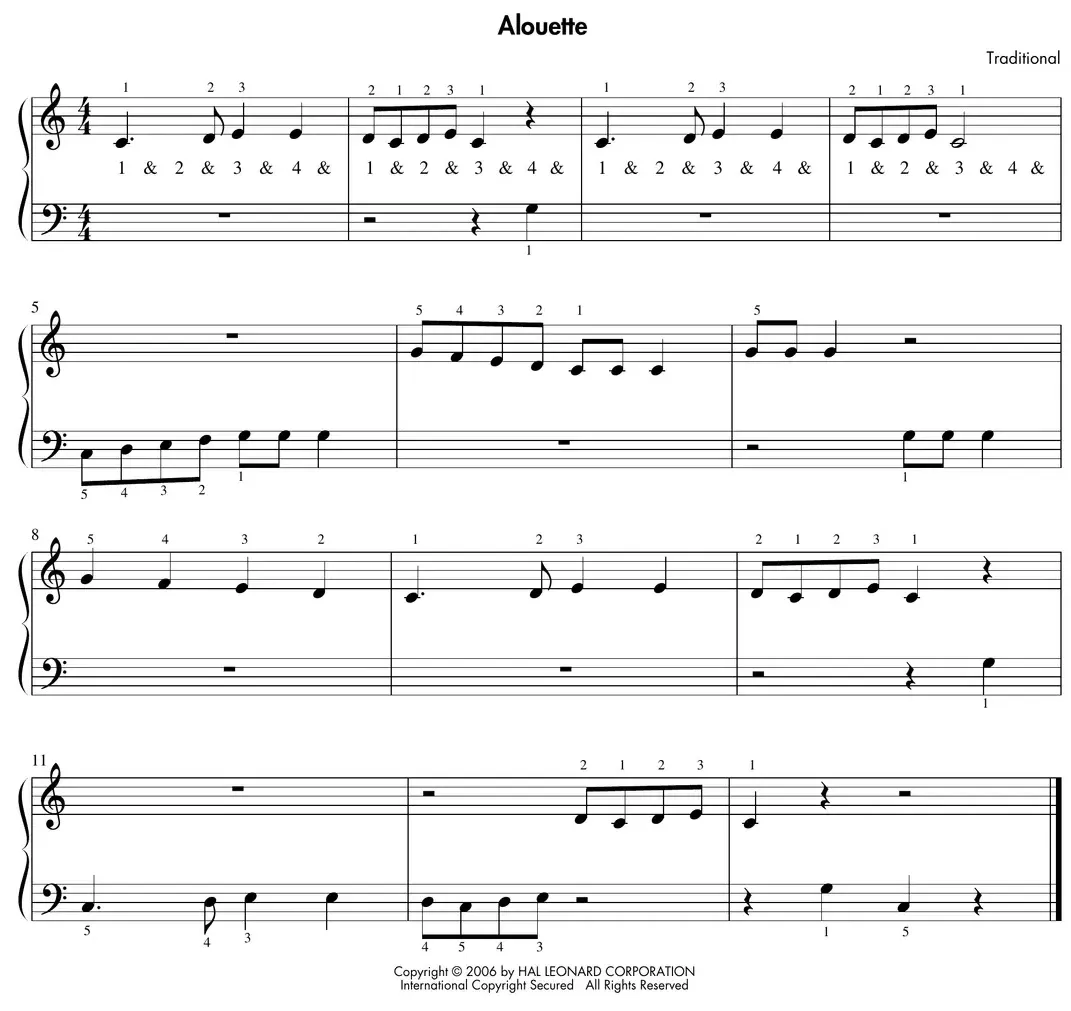
Now it's time for our first song using eighth notes and dotted notes, “Alouette.” This time you get to use two hands, though not at the same time (yet!). Each hand is in C Position as you've learned in previous chapters, and the song is written on the grand staff (right hand on the upper treble staff, and left hand on the lower bass staff). Make sure to follow the fingering numbers next to each note. This song is not recorded, so count carefully. It is good practice to write in the counting for all songs you play, especially when you're learning. The first line has been done for you, but you may pencil in the rest. Go on… you can do it!