Playing, Part 1 · Chapter 9: More Time Signatures
Introducing 6/8 and 12/8 Time
So far we’ve been using time signatures with a “4” on the bottom, meaning that we are counting in quarter-note beats. Now this changes when we introduce the 6/8 and 12/8 time signatures:
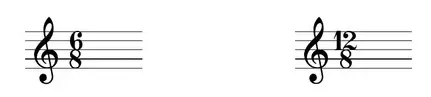
In both cases, the eighth note “gets the beat,” i.e., we are now counting in eighth notes. In 6/8 time there are six eighth-note beats in each measure, and in 12/8 time there are twelve. So a measure of 12/8 time is equivalent to two measures of 6/8 time, and, in many cases, it’s a matter of opinion and preference whether to notate a tune in 6/8 or 12/8.
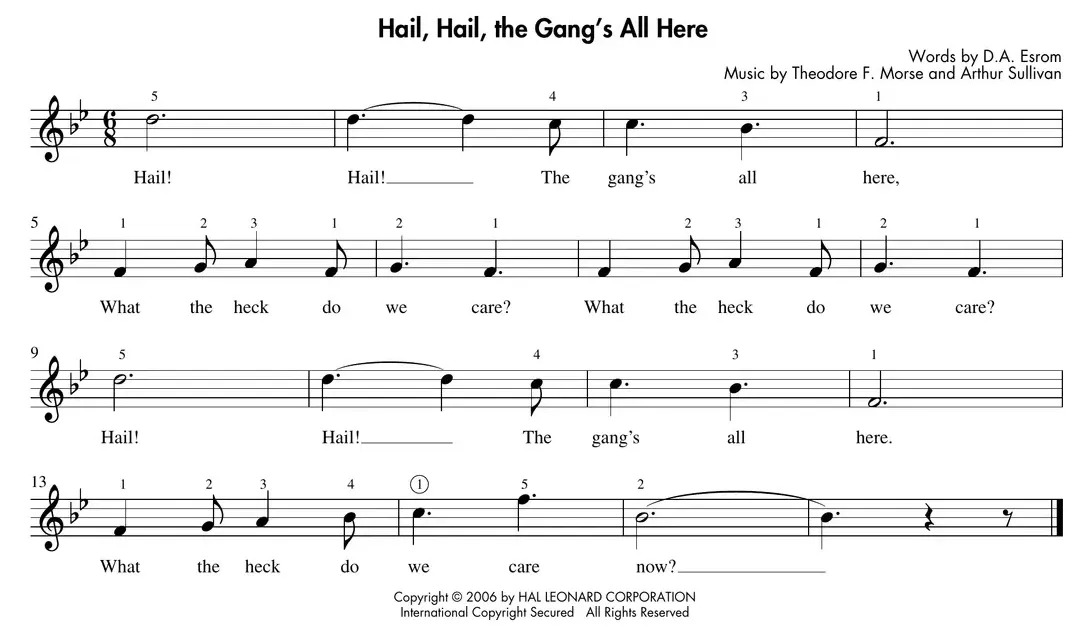
On to another traditional tune, this one in 6/8 time, and in the new key of B♭ major. In Chapter 7 we saw that the key signature for B♭ major was two flats, B♭ and E♭ . So these notes need to be flatted whenever they occur. Note that the range of the song goes from the F (above middle C) up to the D above (excluding the high F in measure 14, for now). So, even though we are in the key of B♭ , it would make sense to base the fingering on an F position in the right hand (with the thumb resting on F) and then extending the pinkie up to D as needed. In the last line we also have a thumb turn, so we can reach the F at the top of the staff.
You can count through this song using 1, 2, 3, 4, 5, 6 for each measure, but don’t forget that each beat now falls on an eighth note. For example, in measure 5, we would count 1, 2 on the first F, then 3 on the G, then 4, 5 on the A, then 6 on the last F.
Here’s a traditional song in 6/8 time, “Hail, Hail, the Gang’s All Here.” Listen to track 23 and first count along, without playing. Next, play along, using the fingering numbers provided.
Loading audio…
Although we have six eighth-note beats in each measure, in 6/8 time we can actually hear Words and Music by Ian Stanley, Roland Orzabal and Chris Hughes two per measure (landing on the 1st and 4th eighth notes). Similarly, in 12/8 time, big beats extras we can hear four big beats per measure (landing on the 1st, 4th, 7th and 10th eighth notes). When playing this example, try tapping your foot on all the eighth notes, then on the big beats (two per measure). Interesting, huh? In meters with an “8” on the bottom, the beat is essentially the dotted quarter note (equal to three eighth notes). When practicing a song in 6/8, first tap and count each eighth-note beat, slowly. As you get more comfortable, speed it up and begin to feel these “big beats” every three eighth notes or on each dotted All Rights Reserved International Copyright Secured Used by Permission quarters. This is actually how meters such as 6/8 and 12/8 are felt .