Playing, Part 2 · Chapter 12: More Chords and Inversions
Diatonic Four-Part Chords and Progressions
Now it’s time to see how these various four-part chords fit into different keys. Do you remember when we found out about the triads that lived within major keys (the diatonic triads in Chapter 10)? Well, now we’re about to do the same thing with these new four-part chords. Here are the diatonic four-part chords contained within a C major scale:

What we’re doing here is building a four-part chord from each note in the C major scale, making sure that all notes used are contained with the scale (which, in the key of C means we are only using the white keys again). This gives us the various chord qualities shown here from left to right (major 7th, minor 7th, minor 7th, major 7th, dominant 7th, minor 7th, and minor 7th with flatted 5th, in that order). Just like we said for the diatonic triads, a lot of songs are written using these diatonic four-part chords!
As with the triads we demonstrated earlier, the Roman numeral under the staff indicates the chord function.
Of course, we can have diatonic four-part chords in any key, not just in C major! So now we’ll derive the four-part chords within a couple more keys, starting with F major:
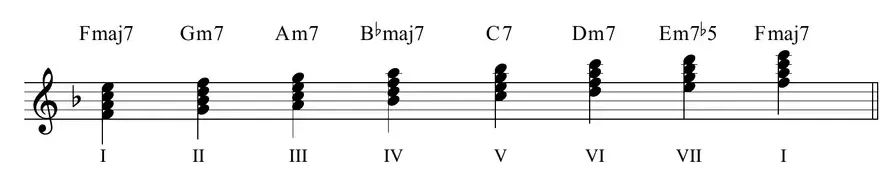
Next, we’ll look at a diatonic four-part chord progression in the left hand, and see how it benefits from inversions and voice leading.
Listen to track 30 to hear a series of left-hand four-part chords in root position. These are all diatonic to the key of F:

Loading audio…
Notice how this sounds rather “disjointed” because we are jumping around in root position. Now with the use of inversions, this left-hand part sounds smoother and more musical.
Listen to track 31 to hear inversions and voice leading applied to the previous progression of four-part chords:

Loading audio…
We will next use these inverted triads to harmonize an excerpt from the famous R&B/pop song “Killing Me Softly with His Song.”
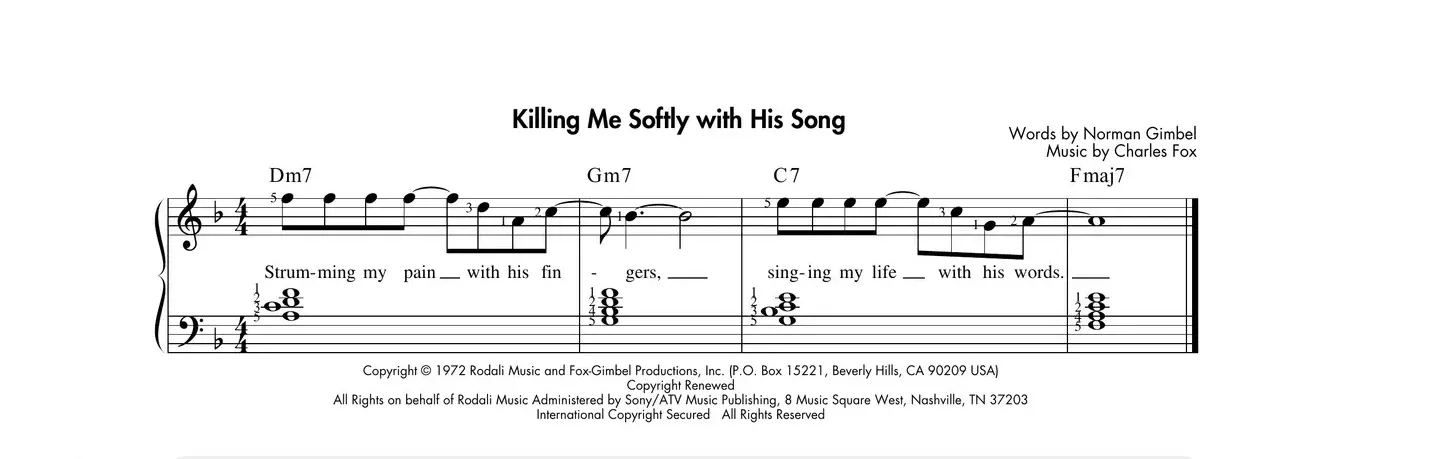
Count through the melody (review the eighth-note counting in Chapter 6 as needed), then work through it and apply the fingerings shown. When the right-hand melody is familiar, add the inverted four-part chords in the left hand!
Finally, in this chapter we’ll examine the diatonic four-part chords in G major, as follows:

Now we’ll take a look at the accompaniment (comping) figure from the classic Santana song “Oye Como Va.” Note that it alternates between two chords: Am7 and D7 (II and V of G major, as shown above). The Am7 chord is voiced in second inversion, to lead smoothly into the D7 chord in root position:
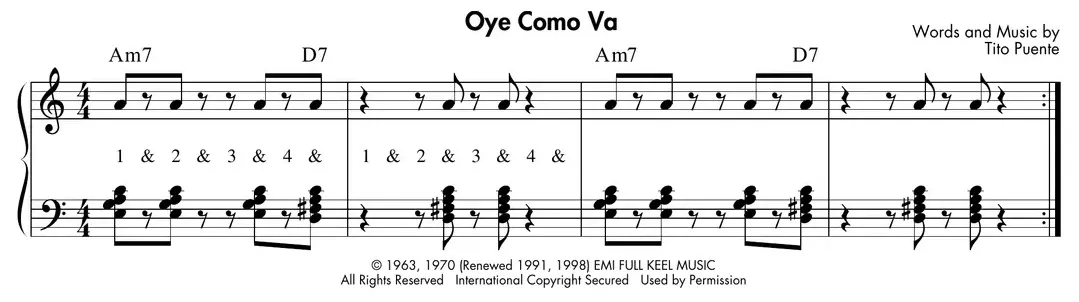
The counting has been written in the first two measures to help you with this syncopated rhythm. Count carefully with all these eighth notes and eighth rests.
A lot of pop and R&B songs are written using diatonic four-part chords, so you should learn them in as many keys (and inversions) as you can!
The song “Oye Como Va” was originally written by Tito Puente, one of the world’s best-known salsa musicians. Santana added some rock elements to their version of the tune, which was included on their groundbreaking Abraxas album, released in 1970. An eclectic mix of rock, blues, salsa, and jazz, this record is a good example of the experimental spirit underpinning the West Coast rock scene in the late ’60s and ’70s.